Why not just practice real estate calls with a general AI chatbot?
You can, and it helps with the words. A general AI chatbot is good for drafting an opener, listing objections and rehearsing replies. A prospecting call is a different skill: speaking out loud, in real time, to someone who is not trying to help you. Practice it by voice, in a set scenario, with feedback on the same habits.
Read the transcript
- A general AI chatbot helps with the words.
- A prospecting call is a different skill: you speak out loud, in real time,
- to an owner who is not trying to help you.
- Practice it in four moves. Use your voice, not the keyboard: speak, and do not read.
- Keep the owner pushing back, with no coaching until the call is over.
- Run the same call five times, with a different owner each time.
- Get feedback on two or three habits you name, then pick one to fix tomorrow.
- Or start where the call starts.
- Choose the lead type, an AI owner answers by voice, and you make the call.
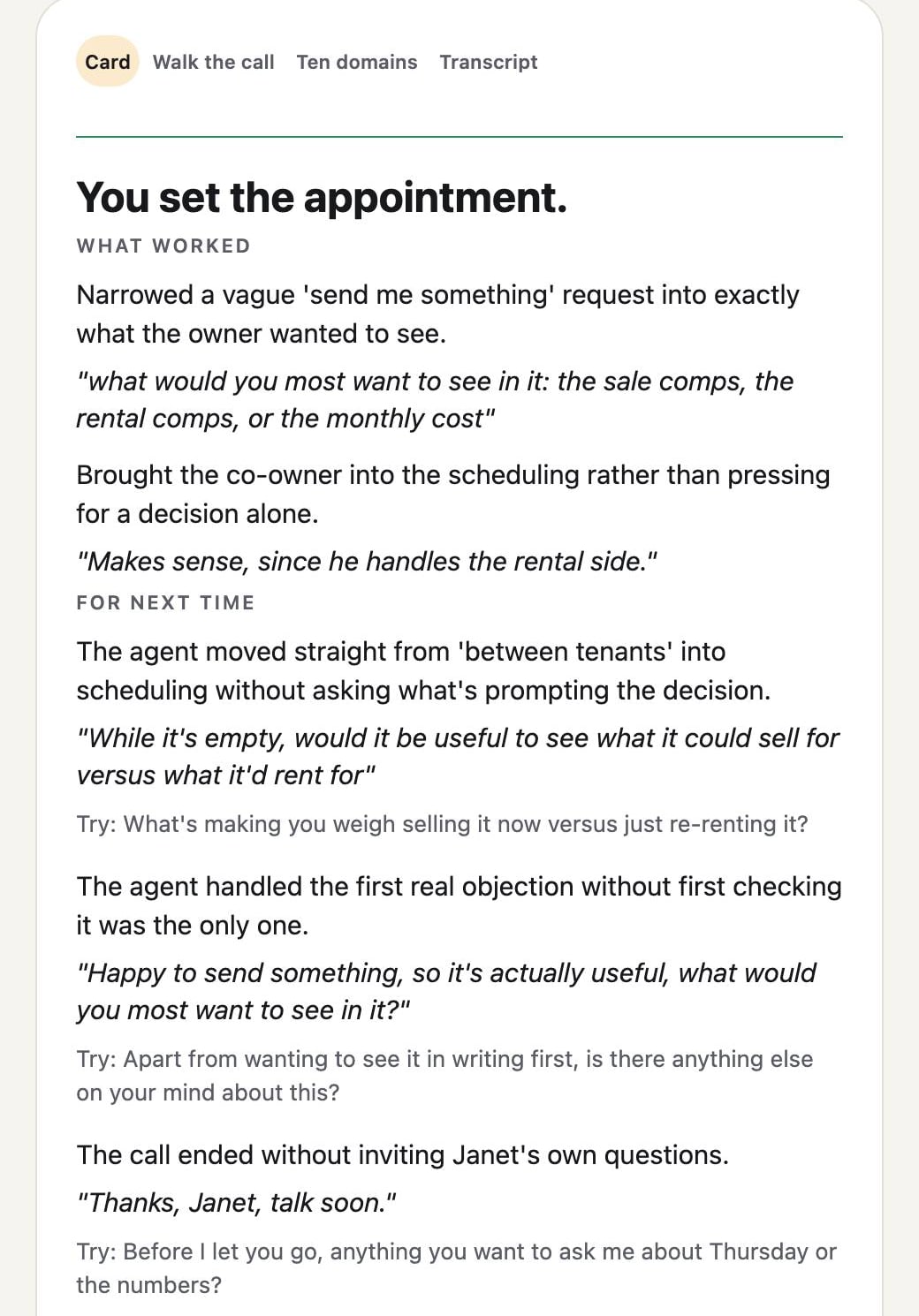
- Then your card shows what went well and the one thing to work on.
- The words you type are not the words you will say under pressure.
- A chatbot can help you write them.
- Saying them out loud, before an owner hears them, is the practice.
- Practice it until it sounds like you.
- Each call runs as long as the conversation needs,
- and you can make as many as you want.
- Practice free at 10before10.com/try.
Drafted with AI by the 10before10 team, reviewed and approved by Grant Freer and Gia Freer, licensed Florida real estate brokers. Updated October 24, 2026. También en español.
What a general AI chatbot does well
A general AI chatbot is a fast helper for the words around a call. If you already use one, these are the jobs it handles well.
- Drafting. A first version of your opener, a follow-up text or a voicemail, which you then rewrite in your own voice.
- Listing objections. The things an owner selling alone or an owner with an expired listing might say, so nothing surprises you.
- Explaining. A concept from a class, a term on a form or a step in a transaction, in plain words.
- Typed rehearsal. Trying a few ways to answer the same objection and seeing which one sounds like you.
That is real help, and you should use it. For the wider picture of where AI fits in an agent's business, and where it should not stand in for you, see AI for real estate agents.
Where call practice asks for more
A prospecting call is spoken, live and pushed back on. That is where a general chatbot needs extra work from you.
The call is out loud. Typing gives you time to think, edit and try again.
An owner on the phone gives you about one breath. If you practice in a chatbot, use its voice mode and do not read from the screen.
The owner is not on your side. A general assistant is built to help the person using it.
A real owner is busy, doubtful and sometimes short with you. You have to tell a chatbot, every time, to push back, to stay in character and to not coach you in the middle of the call.
You write the owner yourself. The practice is only as real as the scenario you describe, and you already know what you wrote. A tool built for call practice starts from the scenario, so your time goes into the call instead of the setup.
Feedback needs a fixed standard. Ask a chatbot "How did I do?" and the answer depends on what you told it to look for.
Decide the habits first, such as asking before telling, finding the real motivation and ending with a clear next step. The page on what a call scorecard should measure lists them.
Progress needs a record. A habit improves over weeks, not in one chat. Whatever tool you use, keep a short log of what you worked on and whether it showed up on real calls.
How to use a general chatbot for practice
If a general chatbot is what you have today, set it up so it acts like an owner:
- Describe the owner. Lead type, situation, mood and one real reason they might sell. Invent every detail. Never paste a real client's information.
- Set the rules. Stay in character, push back like that owner would, raise each objection once and give no coaching until you say "end of call."
- Use voice. Stand up, speak and do not read.
- Run the same call five times. Change one thing about the owner each time.
- Ask for feedback on two or three named habits. Then pick one to fix tomorrow.
What a practice call built for agents adds
A practice tool made for these calls starts where the call starts. You choose the lead type, an AI owner answers by voice and says plainly that it is AI, and you make the call.
Afterward a scorecard shows what went well and the one thing to work on, measured against the same habits every day. You spend your ten minutes calling, not writing prompts.
Neither one replaces the real call. Both should get you to it ready.
What not to do
Do not type your practice and call it rehearsal. The words you type are not the words you will say under pressure.
Do not let the AI coach you in the middle of the call. A real owner will not pause to give you a hint.
Do not paste client details into any AI tool your broker has not approved.
Do not practice only when the call feels easy. The objection you dread is the one worth five runs.
How to practice it
Choose the call you will make most this week. Run it five times by voice, with a different owner each time: friendly, rushed, doubtful, angry and silent. After each run, write one line about one habit.
Then do the same drill with a colleague, so you hear how a person pushes back. Finding the owner's real reason before you offer anything is one of the habits 10before10™'s card listens for.
A chatbot can help you write the words. Saying them out loud, before an owner hears them, is the practice.
Honest answers
Related answers
Make one practice call. See your card.
A prospect who sounds real raises this exact moment. Ten minutes, in the browser, no account. The scorecard tells you the one thing to fix.